





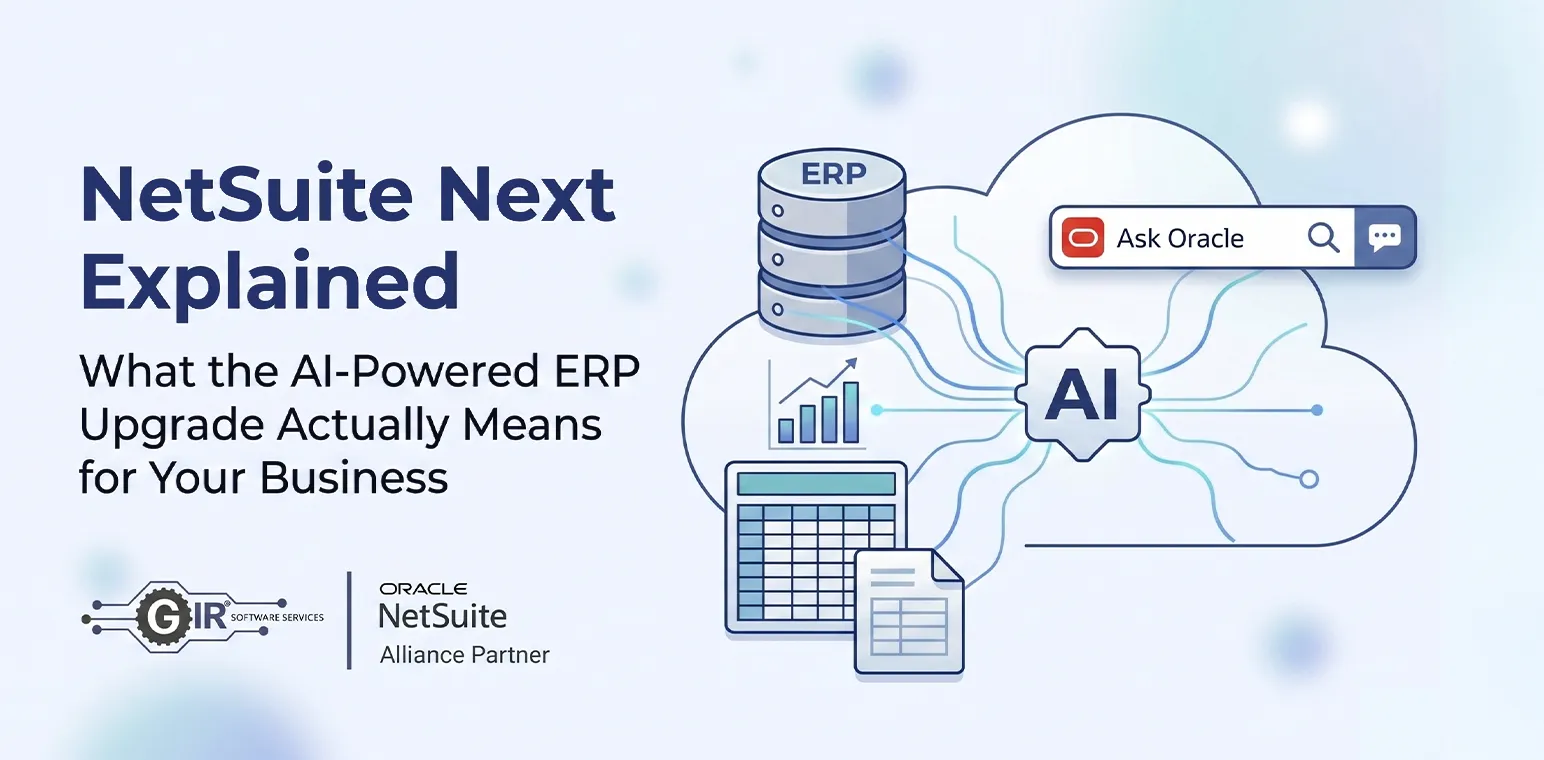
If you have been following Oracle’s announcements in 2025 and 2026, you have heard about NetSuite Next. But between the product demonstrations and the technical documentation, it can be difficult to understand what actually changes for a business running NetSuite today.
This post breaks it down in practical terms: what NetSuite Next is, what it does, and what your organization should be thinking about right now.
NetSuite Next Is Not a New Product
The first thing to understand is what NetSuite Next is not. It is not a separate system to migrate to, a new platform to procure, or a product your team needs to relearn from scratch.
NetSuite Next is an AI-powered upgrade to your existing NetSuite environment. It activates at the account level, is fully backward compatible, and is included in your current NetSuite subscription. No additional license cost has been announced for the core platform. No data migration is required. Your existing customizations, SuiteScripts, and integrations remain intact.
The Interface Changes. The Interaction Model Changes More.
The most visible change in NetSuite Next is the redesigned interface, built on Oracle’s Redwood Design System. It is cleaner, faster, and more modern, with dark mode and a refined record layout.
But the more significant shift is less visible: how your team interacts with the system day to day.
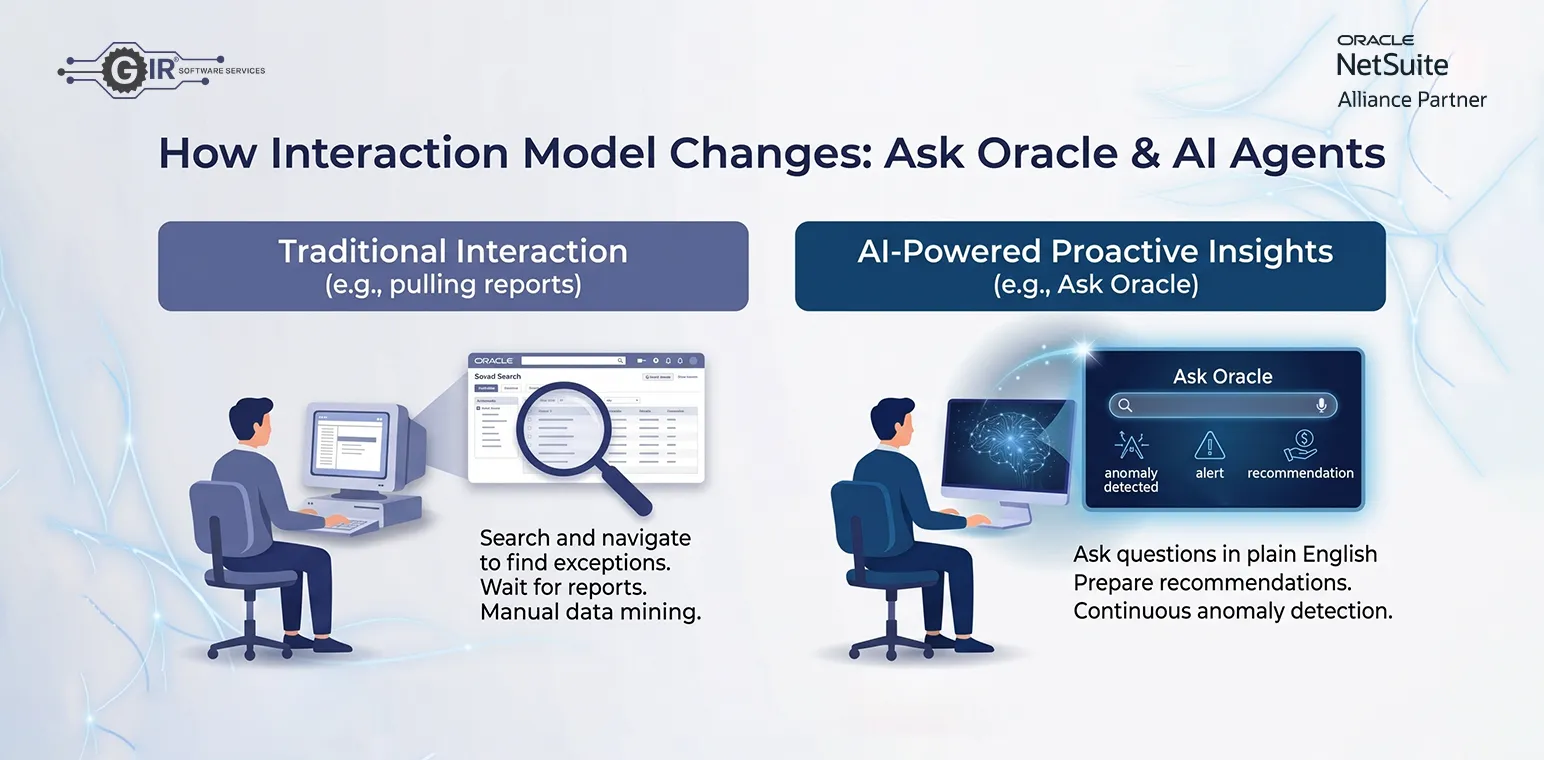
At the center of NetSuite Next is Ask Oracle, a natural language AI assistant that is present across every screen. Instead of navigating menus or running saved searches, users ask questions in plain English and receive answers drawn directly from live NetSuite data. Every insight is traceable back to its source record, report, or transaction.
Ask Oracle is role-aware. A CFO asking about open purchase orders sees financial exposure. A warehouse manager asking the same question sees inventory implications. The system understands who is asking, what they are working on, and what context matters.
What AI Agents Actually Do (and What They Do Not Do)
NetSuite Next introduces AI agents that monitor business operations continuously. Rather than waiting for a user to pull a report, agents detect anomalies, analyze patterns, and surface recommended actions proactively.
A spike in product returns, an overdue approval sitting in a queue, a reconciliation discrepancy at month-end: agents identify these issues and bring them forward with analysis already complete. Your team reviews a recommendation rather than combing through data to find the problem.
An important distinction: by default, agents recommend and prepare. They do not act without human sign-off. The operational model is AI-assisted decision-making. Your team retains final control.
SuiteAgents: Custom AI Agents Built for Your Business
For businesses that want to go further, SuiteAgents is NetSuite Next’s custom agent framework. It allows businesses, or a certified partner, to build AI agents tailored to specific operational workflows directly within the SuiteCloud platform.
Agents are governed by company policies uploaded as documents into the agent’s knowledge base. When policies change, the document is updated and the agent adjusts automatically. No redeployment is required.
On Expected Business Value: What Is Reasonable to Claim
Because NetSuite Next is in a phased rollout and has not yet reached general availability, there are no published performance benchmarks from production deployments. Any specific ROI figures circulating are drawn from controlled demonstrations, not real-world customer data.
What is reasonable to expect, based on documented capabilities:
- Reduced time spent on routine data retrieval, as natural language queries replace manual navigation
- Faster exception handling, as agents surface issues before they reach report review cycles
- Shorter approval cycles, as AI-prepared recommendations reduce the time required per decision
- A more continuous financial close process, with AI monitoring for anomalies throughout the period rather than only at month-end
- Broader data access for non-technical users, who can query the ERP without relying on analysts or IT
The actual impact in any given organization will depend on data quality, configuration, and how deliberately AI capabilities are deployed within existing workflows.
What Your Business Should Do Before the Rollout
NetSuite Next activates when Oracle’s rollout reaches your account. But preparation determines how much value you capture from day one.
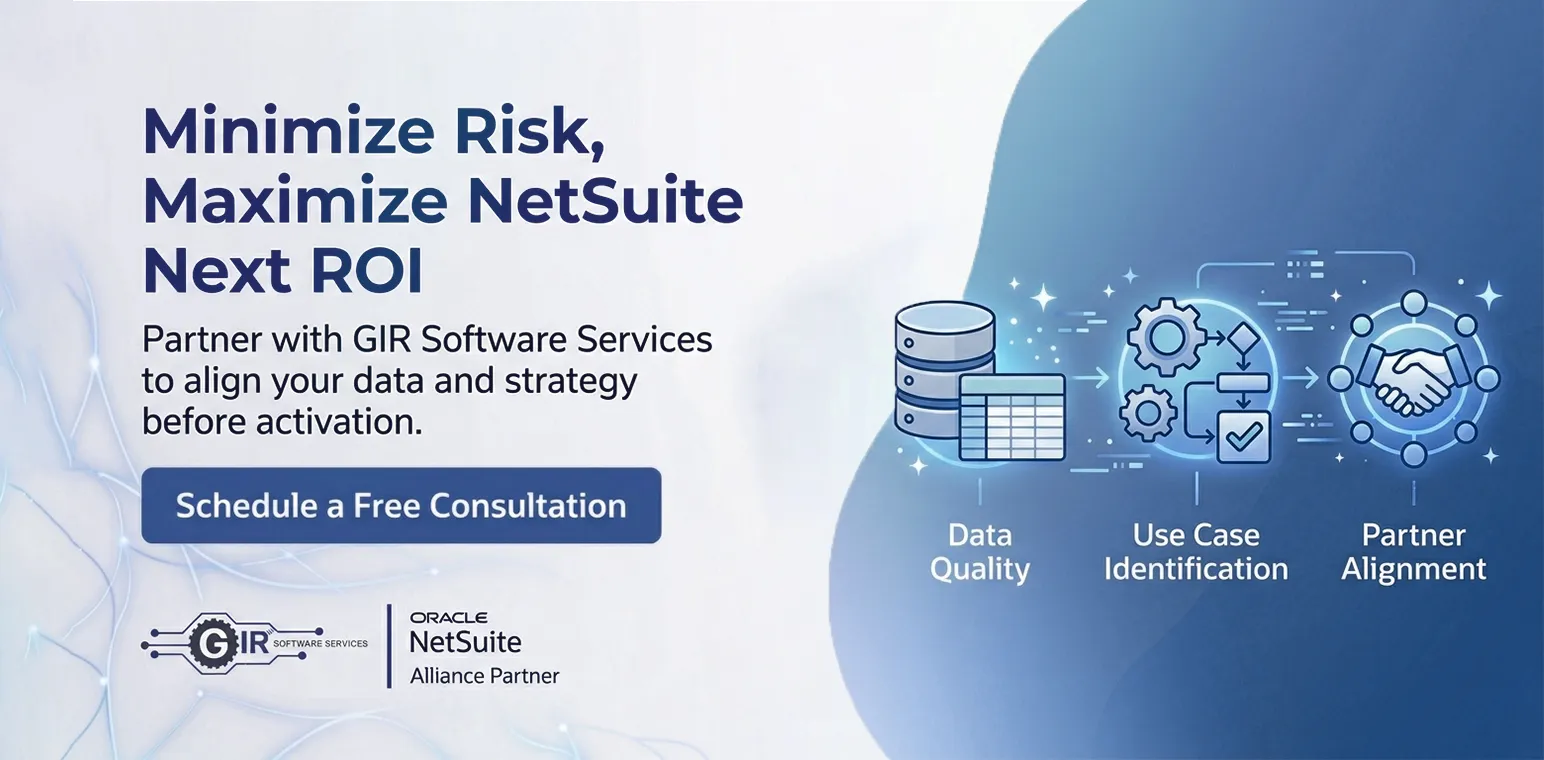
Three areas are worth addressing now:
- Data quality: AI output accuracy is directly tied to the quality and structure of your existing NetSuite data. Incomplete records and inconsistent data entry do not become less problematic when AI is introduced. They become more visible.
- Use case identification: identify two or three workflows where AI-assisted automation or anomaly detection would have the highest operational impact, and document how those processes currently work.
- Partner alignment: ensure your NetSuite implementation partner is up to speed on the rollout timeline and can support your enablement planning ahead of activation.
The organizations that capture value from NetSuite Next earliest will be those that prepared while others waited for the activation notification.
GIR and NetSuite Next
GIR Software Services is an Oracle NetSuite Alliance Partner based in Houston, Texas. We work with NetSuite customers to assess their current environment, identify preparation priorities, and build an activation plan aligned to Oracle’s rollout timeline.
If you want a clear picture of where your NetSuite instance stands and what readiness looks like for your business, the conversation starts with a free consultation.
Recent Posts

Netsuite partners in the usa: ...
Suitecommerce advanced 2026.1:...